
SQL Injection Explained: Types, Examples, Risks, Best Practices

What Is SQL Injection?
Data is known to be the gold of the digital age, making it a popular target for cybercriminals. Hackers use various attack methods to try to gain access to sensitive information and data. One of these attack methods, which directly targets databases, is SQL injection.
In this article, let’s explore what exactly an SQL injection attack is. How does such an attack work? What dangers does it pose to companies, and how can an SQL injection attack be prevented?
SQL injection is one of the many threats covered in cybersecurity. Learn more about cybersecurity threats, types, and best practices.
What Is Meant by an SQL Injection?
SQL (short for Structured Query Language) is a programming language used to create data structures in relational databases and to retrieve and edit the data records stored in those databases.
An SQL injection (SQLi for short) is a type of cyberattack in which attackers manipulate a portion of the SQL code to gain access to the database and the data stored there. Because SQL-based databases are used by many websites and applications, SQL injections represent a common and serious threat.
How Does SQL Injection Work?
Access to data in an SQL database is achieved via SQL statements, which are submitted to the database through an SQL query field. If, due to a vulnerability or security flaw, the statements are not sufficiently validated, attackers can create their own commands and send them to the database.
This allows them to view, modify, or delete stored data or to add new data to the database. Another way to manipulate databases using correctly executed SQL commands is by spoofing the identity of an authorized user. This allows attackers to impersonate database administrators and gain extensive access.
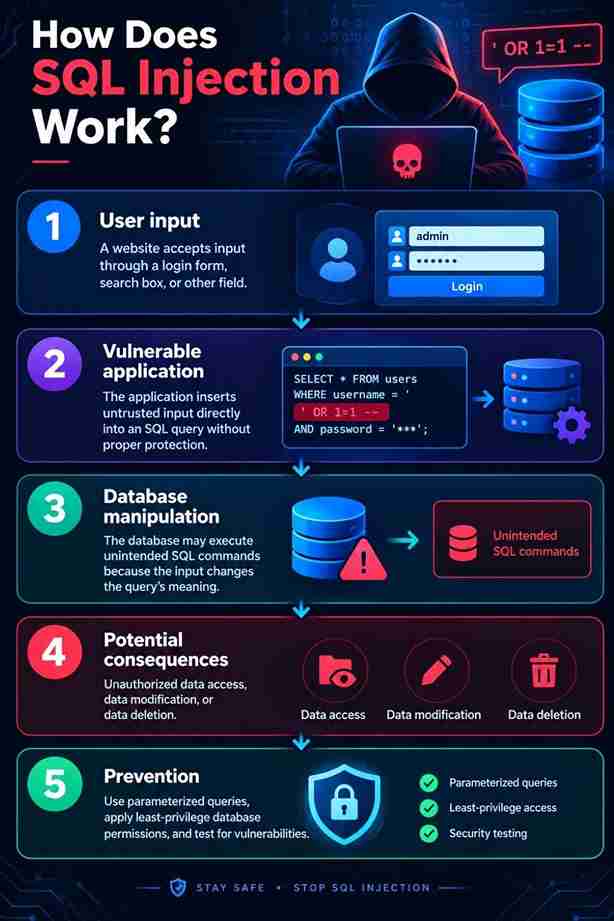
Types of SQL Injection Attacks
| Type of SQL injection | Description |
| In-band SQL injection | By using in-band SQL injection, attackers use the same communication channel to send malicious SQL queries and retrieve the results. |
| Error-based SQL injection | By using the error-based SQL injection, attackers exploit database error messages to gather information about the database structure. |
| UNION-based SQL injection | By using this type of SQL injection, attackers use the SQL UNION operator to retrieve data from other database tables through a vulnerable query. |
| Blind SQL injection | By using blind SQL injection, attackers infer information from the application’s behaviour when the application does not directly display database results. |
| Boolean-based SQL injection | By using this SQL injection type, attackers send conditions that evaluate to true or false and observe differences in the application’s responses. |
| Time-based SQL injection | By using the time-based SQL injection, cybercriminals use database response delays to infer information when other response indicators are unavailable. |
| Out-of-band SQL injection | By using out-of-band SQL injection, attackers use a separate communication channel to retrieve data when the usual response channel is unsuitable. |
SQL Injection Attack Examples: Real-World Incidents
SQL injection attacks can affect both multinational and small companies. Below are some of the examples that show how attackers have exploited SQL injection vulnerabilities to access a company’s sensitive data and compromise many organisations.
TalkTalk (2015)
The British telecommunications provider company has suffered a massive SQL injection attack that exposed the personal details of 156,959 customers. The attackers also gained access to bank account numbers and sort codes that belong to 15,656 customers.
Yahoo Contributor Network (2012)
In 2012 the attackers exploited an SQL injection vulnerability and stole the details of approximately 450,000 email addresses and passwords from Yahoo Contributor Network. The stolen data included the credentials and accounts associated with Yahoo and other services.
Sony Pictures (2011)
The hacking group known as LulzSec used an SQL injection attack against Sony Pictures’ website and gained access to confidential information. The stolen data included names, addresses, phone numbers, and email addresses that belonged to thousands of customers.
MOVEit Transfer (2023)
In 2023, the Clop ransomware group exploited an SQL injection vulnerability in Progress Software’s MOVEit Transfer file-transfer application. This SQL injection attack has affected thousands of organizations, including businesses and government agencies. The attack exposed the sensitive information belonging to millions of people.
SQL Injection Risks and Dangers for Businesses
SQL injection attacks are relatively simple to implement technically and therefore remain a popular attack method among cybercriminals. An SQL injection attack can have serious consequences for small- to large-scale companies.
What Are the Possible Effects of SQL Injection?
Data Loss
If attackers manage to gain access to the database, they can steal all the data stored there. This is particularly dangerous if it involves sensitive data such as customer or financial information.
Reputational Damage
When it becomes known that an organisation has been the victim of an SQL attack in which data from customers, business partners and other third parties has been compromised, this can damage the company’s reputation and, in the worst case, lead to customer churn and the end of business relationships.
Legal Consequences
Data breaches resulting from SQL injection can also have legal consequences. Firstly, individuals affected by the data leak can claim damages from the company. Secondly, violations of data protection regulations such as the GDPR can lead to fines and penalties.
Additional Costs and Financial Damages
Remedying the consequences of the attack may incur additional costs and lead to downtime and restrictions in the operation of websites and applications linked to the database.
How to Prevent SQL Injection Attacks: Security Best Practices
Nowadays, large and small companies are taking extensive measures to ensure the best possible protection against SQL injection attacks. In addition to technical measures, companies are also focusing on training and raising awareness among employees.
Technical Measures to Prevent SQL Injection
- Regular updates: It is critical to regularly update devices, apps or software, as recent updates fix a large number of security vulnerabilities. If you are using the outdated versions, then the vulnerabilities in applications can be exploited by attackers to perform SQL injections.
- Use of database security tools: Using the security tools for database systems can help you to detect and prevent SQL injection attacks.
- Data Input Sanitisation: In SQL, certain characters or words have a defined meaning. To prevent attackers from misusing these characters and words to send commands to the database, the database should be instructed not to interpret these inputs as commands. Another way of cleaning database input is by creating predefined queries. This is where input can be far more easily restricted to a well-defined limit.
- Performing SQL injection tests: An SQL injection test checks whether an SQL-based database offers a potential attack surface for SQL injections in order to find possible vulnerabilities.
- Routine scans: Applications with an attached SQL database should be scanned regularly using appropriate tools. This also helps to identify existing vulnerabilities.
- Setting up a Web Application Firewall: A Web Application Firewall (WAF) checks the incoming traffic of the installed applications and filters out suspicious input to prevent SQL injections.
- Data encryption: Should an SQL injection attack occur despite all precautions, it is important that the data stored in the database is not represented as plaintext but encrypted.
Organisational Measures to Prevent SQL Injection
- Employee training: Employees responsible for maintaining websites and applications linked to an SQL database should be made aware of the dangers of SQL injection and receive training to help them act correctly within their responsibilities.
Immediate measures in the event of unauthorised access include securing database access, analysing vulnerabilities, and notifying the individuals affected by the data breach as well as the relevant supervisory authorities.
Related Articles:
