
Cloud Architecture: Components, Layers, Models, and Security

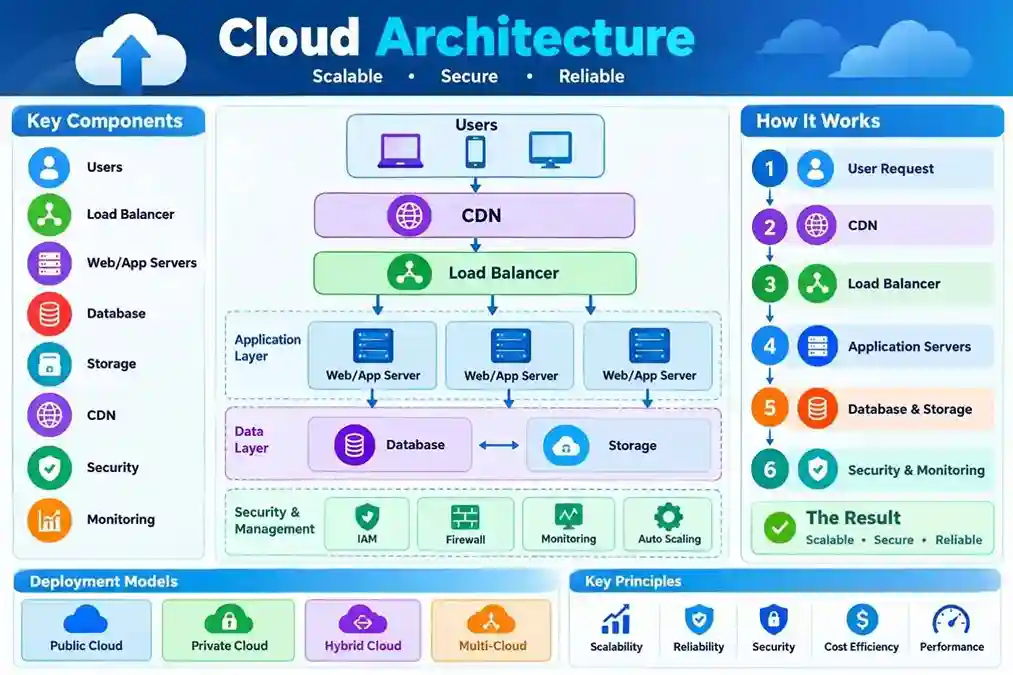
Cloud architecture is considered a blueprint for deploying and running various resources in the cloud. It aims to ensure that all resources interact seamlessly, enabling the company to leverage the cloud effectively. So, what are the resources in question, and how does this type of interaction actually work? In this article, we’ll explore the typical building blocks of cloud architecture, describe the different tiers, and share some of the options for how you can deploy cloud computing.
The Three Main Layers of Cloud Architecture
Every cloud architecture is individually tailored to the needs and operating model of the company. Nevertheless, in most cases it can be broken down into three overarching levels.
1. Hardware Layer
The hardware layer forms the foundation of every cloud architecture. Hardware includes, for example, servers, storage platforms, and networking devices such as switches and routers. The hardware is operated in one or more data centres, depending on the services to which a company subscribes. From there, it provides various resources such as computing, networking, or storage capacity.
2. Virtualization Layer
The virtualization layer obtains resources from the hardware layer and pools them. This ensures that resources are no longer physically limited to a single computer but can be flexibly used in virtual form by different applications or users.
3. Application and Service Layer
The highest level is the application and service layer. At this level, resources are available to end users: via a network in the form of infrastructure services, services, functions, or applications.
Different Models of Cloud Computing
| Cloud Computing Model | Description | Examples |
| Infrastructure as a Service (IaaS) | IaaS provides virtualised computing resources, such as servers, storage, and networking, over the internet. | Amazon EC2, Microsoft Azure Virtual Machines, Google Compute Engine |
| Platform as a Service (PaaS) | Paas provides a platform for developers to build, test, and deploy applications without managing the underlying infrastructure. | Google App Engine, Azure App Service, Heroku |
| Software as a Service (SaaS) | Saas delivers software applications over the internet, usually through a web browser or app. | Google Workspace, Microsoft 365, Salesforce |
To understand these cloud service models in more detail, read our guide to Cloud Services: What Are IaaS, PaaS, and SaaS?, which explains how each model works and compares their responsibilities.
Key Components of Cloud Architecture
Overall, numerous technological components are used at the various levels. These include, for example:
- Automation and management software
- Databases
- Virtual machines
- Communication applications
- Service meshes
- Container environments
- User Interfaces
- Front-end platforms
- APIs
Cloud Security Architecture: Essential Security Measures
Companies should supplement traditional security measures with a cloud security architecture. Responsibility for the security of the cloud infrastructure often lies not solely with the cloud provider, but also partly with the company itself. To ensure the security of data, systems, and infrastructure, companies should implement comprehensive security measures, such as…
- Identity and Access Management
- Multi-factor authentication
- Firewalls
- segmentation
- Data classification
The Role of a Cloud Architect in a Company
The primary task of a cloud architect is to develop and implement an optimal cloud architecture for the company. This role involves IT experts who oversee the development, implementation, and subsequent management of the cloud architecture. Depending on the role distribution defined by the cloud operating model, this task can be outsourced to an external IT service provider or, alternatively, assigned to an internal employee as part of the Cloud Competence Center. As cloud strategies and their associated architectures become increasingly complex, comprehensive expertise is now required – some companies therefore hire a dedicated cloud architect to reliably guide the transformation.
Choosing the Right Cloud Architecture Strategy
Developing a customised cloud architecture requires a tailored approach. Companies should tailor their cloud landscape to their specific needs, whether through IaaS, PaaS, or SaaS, combined with a private, open, hybrid, or multi-cloud strategy. It is important to carefully choose technology components and security measures. Cloud architects are key, as they contribute skills and experience and are integral to delivering the change and driving the business forward.
Also Read: What Describes The Relationship Between Edge Computing And Cloud Computing
