
Code Wiki: What It Is and How It Helps Coding Teams

In teams where code is the core of the product, documentation often becomes one of the weakest elements of the system. Not because it doesn’t exist, but because it’s scattered across repositories, tickets, loose documents, and informal conversations. Over time, this fragmentation creates dependency on key personnel, technical decisions that are difficult to justify, and friction between teams.
Code Wiki, a Google initiative, starts from a clear foundation: technical documentation should be designed for coding teams, not as an external artifact, but as a natural extension of the system that evolves alongside it.
What Is Code Wiki?
Code Wiki is a platform for automatically generating and maintaining structured documentation for code repositories. Its focus is on documenting code repositories, including their structure and how the code works.
The documentation on Code Wiki is not a static/one-time task. It is supposed to be continually updated as there are new additions to the code repository. This will make the documentation useful even after the system evolves or the team changes.
Why Is Code Wiki a Better Fit for Coding Teams?
| Code Wiki Benefit | Value for Coding Teams |
| Technical decisions with context | Helps teams understand why decisions were made |
| Reduced tribal knowledge | Makes technical knowledge less dependent on individuals |
| Daily documentation access | Makes information easier to consult during development |
| Complex system documentation | Supports documentation for complex systems |
Traditional documentation can become difficult to maintain when it is separated from the code. In coding teams, documentation only adds value when team members consult it daily and it reflects the technical reality of the system.
In practice, Code Wiki fits especially well in coding teams because of context, context,
- It allows you to document technical decisions along with their context, not just the final result.
- It reduces dependence on individual or “tribal” knowledge.
- It makes it easier to consult the documentation as part of daily work.
- It can support documentation for complex systems.
This approach helps documentation to stop being a passive repository and become an active tool for the team.
How Does Code Wiki Fit Into the Software Development Lifecycle?
Here‘s where Code Wiki stands out as the best-suited environment for a coding team. Having a timeframe for a piece of software brings realization to the fact that Code Wiki is not merely a place to keep documentation; it‘s a way to link the technical decisions, code and operation of a system, as it allows knowledge to evolve alongside the system.
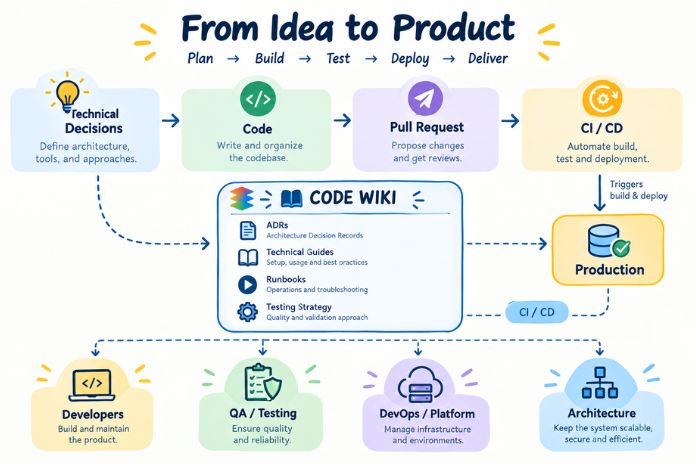
This method avoids creating documentation in separate places and instead integrates it into the workflow, from the decision to implement the system in production through to how it is implemented and maintained.
How to Document Technical Decisions With Code Wiki
One of the most common uses of Code Wiki is documenting decisions that directly affect the code and its architecture. This type of content is especially valuable when the system grows or when new members join the team.
A typical example is the documentation of an architectural decision:
- Decision: adoption of hexagonal architecture
- Context: difficulty in testing business logic due to tight coupling
- Alternatives considered: layered architecture, traditional MVC
- Consequences: improved testability and maintainability, in exchange for greater initial complexity
This type of documentation usually includes:
- The problem or technical context.
- The alternatives evaluated.
- The decision has been made.
- The medium and long-term consequences.
Documenting decisions in this way allows us to understand not only what was decided, but also why, avoiding revisiting past decisions without the proper context.
How Code Wiki Supports the Day-to-Day Work of Technical Teams
Developers
For developers, Code Wiki serves as a constant reference source. On a daily basis, it’s typically used for:
- Consult style guides and conventions.
- Review past technical decisions before modifying the code.
- Find examples of using internal APIs or shared components.
This reduces unnecessary interruptions and increases the team’s autonomy.
Also Read: Top 5 Reasons Why Developers Should Consider Online Android Emulators
QA and Testing
In QA, Code Wiki helps align development and quality from the early stages. It is commonly used for:
- Document technical acceptance criteria.
- Share testing strategies by layer.
- Maintain automation conventions and best practices.
In this way, the definition of quality is shared among all technical roles.
DevOps and Platform
For DevOps profiles and platforms, Code Wiki can serve as an operational reference source. It typically centralises:
- Pipelines and CI/CD flows.
- Incident runbooks and procedures for action.
- Operating standards and infrastructure decisions.
This approach reduces reliance on implicit knowledge and improves responsiveness to production problems.
Which Teams Benefit Most From Code Wiki?
Code Wiki provides special value in teams that:
- They work with distributed systems or systems of a certain technical complexity.
- They have several roles collaborating on the same codebase.
- They need to speed up the technical onboarding process.
- They are continuously evolving the system.
In these contexts, centralizing technical knowledge and keeping it up-to-date allows teams to scale without losing consistency or quality.
What Are the Best Practices for Using Code Wiki Successfully?
1. Document Only What Provides Real Context to the Code
Documentation is useful when providing reasons for the system‘s current state, rather than restating information that can be read in the code. Considering this, the decisions, modifications, and technical factors describing the code have taken priority and not have secondary focus.
2. Link the Documentation to Specific Technical Decisions
Documenting the context and alternatives of a technical decision allows for understanding the system in the long term and reviewing it judiciously when requirements or the environment change.
3. Review and Update It When the System Changes
Documentation must evolve alongside the code. Integrating its review into regular workflows prevents Code Wiki from becoming obsolete and losing its usefulness.
4. Prioritise actionable. Real-Life Examples and Cases Over Theoretical Explanations
Practical examples reduce ambiguity and make the documentation more actionable. Real-world cases and concrete excerpts facilitate its reuse in daily technical work.
What Is the Value of Code Wiki for Complex Technical Teams?
Code Wiki is designed for coding teams because it sees documentation as part of the system, not an external add-on. By focusing on decisions, processes, and operational knowledge, it can support documentation, collaboration, and knowledge sharing within technical teams.
For developers, QA, DevOps, platform and architecture, having a knowledge base designed from this perspective makes a real difference in how software is built and maintained.
Also Read: How Communal Coding Spaces Are Building The Next Generation Of Developers
