
Most Used Programming Languages In 2026
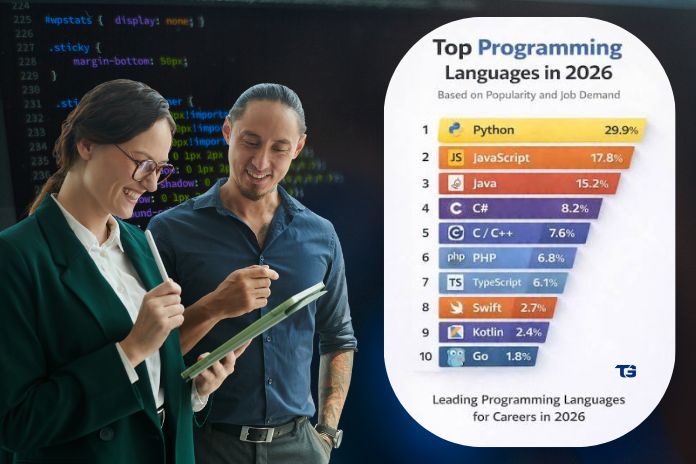
Programming languages help humans communicate with computers by providing instructions for them to follow. These programming languages use specific rules and syntax to create instructions that computers can process and execute. This allows computers to process large amounts of complex information and perform a wide range of tasks and functions.
The programming languages allow computers to process large and complex amounts of information quickly and almost automatically. In this article, let’s explore the most used programming languages, their main features, and the comparisons.
Here Are The Most Used Programming Languages In 2026
1. Python: A Leading Language For AI And Data Science
Python is a programming language most widely used for artificial intelligence projects and big data applications. It is popular because it is an open-source, versatile, and user-friendly-to-learn language. Because of its flexibility and simple syntax, it is one of the most widely used programming languages among top companies.
Characteristics:
- Application: Development of artificial intelligence, machine learning, big data, and task automation.
- Difficulty: Effortless. Ideal for beginners.
- Companies: Google, Netflix, Instagram.
2. JavaScript: A Core Language For Web Development
JavaScript is one of the most popular programming languages in the world, known for its ease of use and compatibility with all browsers. It is the preferred option for chats, calculators, information search engines, and other visual and interactive elements.
This interactive nature is what makes it so popular in the area of video games. JavaScript is used for both frontend and backend development. The truth is that almost all websites, even those built with another programming language, use some JavaScript.
Characteristics:
- Application: Dynamic web pages, animations, and complete web applications (frontend and backend with Node.js).
- Difficulty: Medium.
- Companies: Facebook, YouTube, eBay.
3. Java: A Popular Choice For Enterprise Applications And Android
Java has been the most widely used programming language for many years, undoubtedly due to its simplicity compared to other options.
It originated in the 1990s and is part of Android, one of the world’s leading mobile platforms. It currently has over 9 million developers using it and is present on more than 7 billion devices worldwide. It is compatible with most systems and is highly scalable, which is why it is almost always the first choice of large companies.
This programming language is statically typed, which makes it fast and straightforward to maintain. Another advantage is its backward compatibility, which saves time and money for companies that use it because they don’t have to rewrite the code with each new version.
Characteristics:
- Application: Large banking systems, large-scale enterprise applications, and native Android development.
- Difficulty: Medium-High. Strict syntax.
- Companies: Uber, Amazon, LinkedIn.
4. PHP: A Popular Language For Server-Side Web Development
The classic server-side ( backend ) development engine that powers the vast majority of websites worldwide.
Characteristics:
- Application: Creation of dynamic web pages, online stores and maintenance of WordPress-based sites.
- Difficulty: Easy-Medium.
- Companies: Wikipedia, Facebook, Tumblr.
5. SQL: A Language For Database Management
SQL is a domain-specific language designed to manage relational databases. It was created in IBM laboratories for the purpose of managing, protecting, and retrieving online information.
That is why it is a language widely used in the field of cybersecurity. This language is effortless to learn, as it follows a fairly standardized methodology for interacting with the database.
Furthermore, in terms of syntax, it is very similar to the English language.
Characteristics:
- Application: Data extraction for reports, organization of customer information (CRMs), and web analytics.
- Difficulty: Effortless.
- Companies: Companies that handle data (Uber, Netflix, etc.).
6. C#: A Popular Choice For Game Development And Microsoft Applications
C# is another object-oriented programming language that Microsoft developed in 2002 for use in enterprise apps.
Most common uses? Windows programs and web applications. It uses similar operators to C++, is case-sensitive, and has a similar syntax.
C# is an evolution of the C and C++ programming languages, but it stands out for its simplicity.
Characteristics:
- Application: Development of multiplatform video games (PC, consoles, mobile) with the Unity engine and desktop applications.
- Difficulty: Medium-High.
- Companies: Microsoft, Stack Overflow, Blizzard.
7. Go And Rust: High-Performance Languages For Modern Software
State-of-the-art technologies created to solve the speed, concurrency, and security problems of older languages.
Characteristics:
- Application: Cloud server infrastructure, cryptography, blockchain, and high-speed tools.
- Difficulty: High.
- Companies: Google (creator of Go), Mozilla (creator of Rust), Dropbox.
Which Programming Language Should You Learn For Your Career?
| Language | Specialty / Main Use Case | Learning Difficulty | Job Demand | |
| Python | Artificial intelligence, data science, automation, and backend web development | Easy / Very Intuitive | Very High | |
| JavaScript | Frontend development, interactive websites, and backend development with Node.js | Medium | Very High | |
| SQL | Database management, data analysis, and data querying | Easy | High / Widely Used | |
| Java | Enterprise applications, banking systems, business software, and Android development | Medium to High | High / Stable
|
|
| PHP | Server-side web development, including WordPress and other CMS platforms | Easy | High / Commonly Used |
Conclusion
Programming languages play a very important role in fields such as technology and software development. Each programming language has its strengths and has unique applications. These programming languages are used to build websites, develop mobile apps, work with data, or create games. These programming languages have high demand in the job market. In 2026, choosing the right programming language can help you to reach your career goals.
Also Read:
